
LiteraturePublished recommendation
The Lord of the Rings
A fellowship undertakes a desperate journey through Middle-earth. Friendship, mercy, temptation and sacrifice give its great adventure lasting moral depth.

Peter Kreeft is a Catholic philosopher and author known for making questions of faith, reason and the good life approachable.
His selections bring philosophy, spiritual classics and imaginative literature into the same conversation.
50 verified · 0 secondary evidence · 9 unverified
Several published lists combined. Anthologies and adapted editions are not automatically equivalent to the recommended work.
A fellowship undertakes a desperate journey through Middle-earth. Friendship, mercy, temptation and sacrifice give its great adventure lasting moral depth.

Newman’s poem follows a dying man’s soul toward judgment, turning Christian hope and the fear of death into dramatic verse.

An introduction to John Paul II’s theology of the body, exploring how embodied life relates to love, marriage, and human dignity.

What makes a life good? Aristotle examines happiness, friendship, character, and the habits through which people learn to act well.

Plato’s dialogue asks what justice means for both a city and a person, opening larger questions about education, truth, and power.

Lewis asks whether miracles are possible and what accepting them would mean for our understanding of nature and Christianity.

Linked stories of humanity’s encounters with Mars explore longing, conquest, loss, and the unsettling baggage people carry into new worlds.

A supernatural novel in which fear, self-absorption, and the willingness to bear another’s burdens have consequences beyond ordinary sight.

Tolkien’s great mythology of creation, rebellion, and loss supplies the ancient background to Middle-earth and its struggle against evil.
A grieving prince investigates his father’s death. His pursuit of revenge draws the court into questions of conscience, truth and responsibility.

Lewis recalls the intellectual and imaginative journey that led him toward Christian belief, with elusive experiences of joy as a recurring thread.

A collection centered on Eliot’s modernist poem of cultural fragmentation and spiritual thirst. Its dense allusions reward patient, repeated reading.

Chesterton transforms the naval battle of Lepanto into a ringing narrative poem, rich in rhythm, historical imagery, and religious symbolism.

A prisoner’s dialogue with Philosophy asks where happiness can be found when fortune collapses. It weighs freedom, providence and the limits of worldly success.

Plato presents Socrates’ defense before his Athenian judges, raising enduring questions about conscience, wisdom, and the examined life.

Lewis considers how suffering can coexist with belief in a good God. A philosophical exploration rather than a promise of easy consolation.

After civilization’s collapse, a monastic community preserves the remnants of human learning. This novel asks what knowledge can—and cannot—do to save us.

Ordinary days in a small town become a meditation on love, mortality, and the beauty people overlook while living their lives.

Thomas More’s refusal to surrender his conscience drives this drama of friendship, political pressure, and the cost of integrity.

A retelling of the myth of Cupid and Psyche explores possessive love, self-knowledge and the difficult search for truth.

A family tragedy opens into questions of freedom, suffering, belief and responsibility. Its conflicting voices reward a patient, attentive reading.
Pascal’s unfinished reflections probe greatness and misery, reason and belief. Its fragmentary form rewards returning to individual passages.

A searching autobiography addressed to God: Augustine follows desire, ambition and grace from his youth through conversion. Later books turn to memory, time and creation.

Reflections on receiving the present moment in trust and surrender to God. The text invites readers to seek holiness within ordinary circumstances.

Thérèse’s account of ordinary love and trust in God introduces her “little way.” Small acts become a serious response to the call to holiness.

A sweeping account of humanity and Christianity that asks what makes the human person—and the person of Christ—different.

Percy uses the form of a self-help book to unsettle comfortable ideas about identity, language and modern life. Satire opens into serious philosophical questions.

Chesterton’s portraits of Francis and Aquinas bring two contrasting saints together, inviting readers to encounter their spiritual and intellectual vitality.

Augustine considers the purposes of earthly society and the city of God against the upheaval of Rome. A long work of theology, history and moral reflection.

Carroll considers Our Lady of Guadalupe within the history of Mexico’s encounter with Christianity, presenting a Catholic historical narrative.

Letters and conversations about turning ordinary work into loving attention to God. Its short sections lend themselves to a few minutes of daily reading.
Chesterton introduces Thomas Aquinas through a lively portrait of his character and thought. An inviting doorway into a much larger philosophical world.

Vanauken’s memoir recounts love, Christian conversion, and bereavement, asking how profound loss can change a life of faith.

Merton recounts the restless years that led him toward Catholic faith and monastic life. A conversion memoir shaped by intellectual searching and the desire for God.

A fantastic journey from a gray town toward heaven becomes Lewis’s exploration of freedom, attachment, and the refusal of joy.
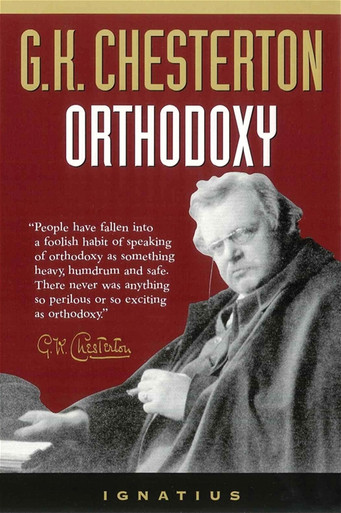
Chesterton retraces his discovery of Christian belief through wonder, paradox and common sense. Read it as an intellectual adventure rather than a systematic catechism.

Letters from a senior devil to his apprentice expose the small habits of pride, distraction, and self-deception that corrode spiritual life.

The final Narnian adventure confronts deception, loyalty, and the end of a world, bringing Lewis’s imagined realm toward its conclusion.

Two children and a marsh-wiggle search for a missing prince, facing enchantment and the difficulty of remaining faithful to their instructions.

A voyage through distant islands becomes an adventure of temptation, courage, and longing for the world beyond the eastern sea.

The children return to a changed Narnia, where a young prince struggles to restore a forgotten inheritance against usurping power.

A boy and a talking horse flee toward freedom, discovering that their journey belongs to a larger story than either understands.

Four children enter a land held in winter, where betrayal, sacrifice, and courage shape their encounter with Aslan.

An experiment with strange rings carries two children between worlds, revealing the beginnings of Narnia and the consequences of curiosity and choice.

Lewis builds a case for shared Christian belief from moral experience, then explores faith, conduct and the transformation of the person. It is not a specifically Catholic catechism.

Lives divided between London and revolutionary Paris converge in Dickens’s novel of injustice, sacrifice, and the possibility of redemption.

A manufactured society trades freedom, family and truth for comfort. Its imagined world raises difficult questions about human dignity and happiness.
A vast, question-by-question exploration of God, creation, human action and Christ. Best approached with a guide or a carefully chosen sequence of questions.
Three lectures on education, moral judgment and what happens when human values are treated as merely subjective.
An account of the forces that formed Christian civilization, connecting the Church’s history with its surrounding cultures.
A study of the divisions of Western Christianity and their consequences for European culture.
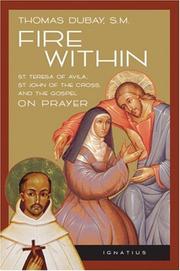
Dubay introduces the contemplative teaching of Teresa of Avila and John of the Cross, connecting their writings with growth in prayer.
Hildebrand reflects on spiritual direction, inviting readers to consider the guidance and formation involved in a serious interior life.

On a new world, Lewis reimagines temptation and obedience through a struggle whose outcome reaches beyond one person’s choices.
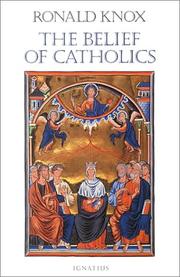
Knox explains the foundations of Catholic belief, offering an apologetic account for readers examining why the Church makes its claims.
Medved argues that popular entertainment is often at odds with American values, offering a critical perspective on film and cultural influence.
Kilpatrick examines moral education and argues for the formation of character, challenging approaches he considers inadequate for teaching right and wrong.
Frankl connects his experience of concentration-camp imprisonment with reflection on the human search for meaning amid suffering.
Howard contrasts a world understood as mere chance with one experienced as meaningful, exploring the imagination’s role in religious understanding.